Neptune’s Moons: Remnants of a Lost World
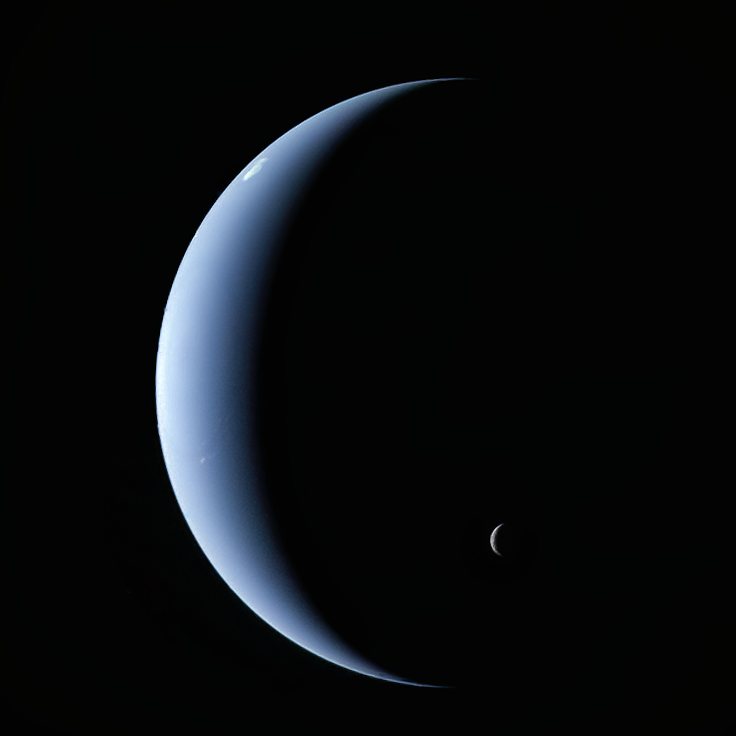
The most distant of our Solar System's four giant planets has always been something of an oddball. Unlike Jupiter, Saturn, and Uranus, with their orderly families of large moons, Neptune has just one dominant satellite: Triton. Everything else is small, irregular and, at first glance, rather unremarkable. Yet, this is about to change.
New observations from the James Webb Space Telescope (JWST), available here, suggest that Neptune's small inner moons may actually be the shattered remains of much larger worlds that existed billions of years ago. If that interpretation is correct, then these tiny moons may be fragments of its lost past.
When Voyager 2 flew past Neptune in 1989—the most extraordinary planetary flyby ever taken, in my opinion—it transformed our view of the planet. Among its many discoveries were several small moons orbiting close to Neptune and its rings: Naiad, Thalassa, Despina, Galatea, and Larissa. Since then, astronomers have been trying to understand why Neptune's satellite system looks so different from those of the other giant planets. The obvious clue is Triton.
Triton is enormous compared with Neptune's other moons, accounting for more than 99% of the mass of the planet's entire satellite system. More intriguingly, it travels around Neptune in a retrograde orbit, meaning it moves in the opposite direction to the planet's rotation. This is a giant red flag for planetary scientists. Rather than having formed peacefully alongside Neptune, Triton is thought to have originated in the Kuiper Belt (hence its similarity with dwarf planet Pluto) and was subsequently captured by Neptune's gravity. And capturing an object as large as Triton would hardly have been a gentle affair.
One possibility is that Neptune originally possessed a much more conventional family of large icy moons, similar to what we can see with Uranus. When Triton arrived, its gravitational influence destabilised those moons, triggering collisions and smashing much of the original system apart. The question is: can we find any evidence that this actually happened?
Researchers used the James Webb Space Telescope's near-infrared spectrograph to examine three of Neptune's inner moons: Larissa, Galatea and Proteus, as well as Neptune's rings (see my article in 2022 on JWST's observation here). This was the first time spectroscopy had been obtained for these tiny moons, and the results were unexpected. Larissa, Galatea and the rings contain signatures of magnesium-rich phyllosilicates, which are essentially clay-like minerals. These minerals are particularly interesting because they form when rock interacts with liquid water. And that creates a rather obvious problem. Larissa and Galatea are tiny, cold moons orbiting in the outer Solar System. They are far too small to have generated and retained the internal heat necessary to melt large quantities of their own water ice; they are far smaller than Saturn's water-rich moon Enceladus, for example. Their surfaces are certainly not places where liquid water is expected to have existed.
So where did the clay come from?
The simplest answer is that it did not form on these moons at all. Instead, the minerals appear to have originated deep inside much larger bodies, where radioactive heating and other processes such as tidal heating could have produced enough warmth for liquid water to interact with rock. In other words, JWST may be looking at material that was once buried deep inside larger icy worlds. And those worlds may no longer exist.
Let's roll back time to better grasp what might have happened. Imagine Neptune billions of years ago, surrounded by a family of substantial icy moons. Then Triton arrives.
Its gravitational influence destabilises the system. Moons collide with one another, fragments are thrown into space, and enormous amounts of material are pulverised into debris. Some of that debris eventually settles into the rings we see today, while some slowly comes back together to form new, much smaller moons. This is the scenario the new observations support.
The fascinating part is that the destruction would have effectively turned those ancient moons inside out. Material that was once safely buried in their interiors would have been exposed to space. And some of that material may still be sitting on the surfaces of Neptune's moons today. This is what makes the discovery so exciting. Usually, when planetary scientists want to understand the interior of a distant icy world, they have to rely on indirect evidence. We cannot simply drill into a moon billions of kilometres away. Here, nature may have done the drilling for us.
There is another intriguing aspect to the discovery. The researchers found the magnesium-rich phyllosilicate signature on Larissa and Galatea, as well as in Neptune's rings, but not strongly on Proteus. This suggests that the debris from the ancient collision was not distributed evenly. Even more intriguingly, the observations revealed another hydrated mineral signature that the team has not yet been able to identify.
This is a wonderful reminder of how much remains unknown about the outer Solar System. We often think of the planets and moons as familiar objects, but our knowledge of their detailed composition is remarkably incomplete. In fact, the clay-like minerals detected around Neptune are unlike anything previously identified in the outer Solar System beyond Jupiter.
For me, what makes this story particularly fascinating is that it changes the way we should think about Neptune's moons. They may now be giving us access to the interiors of worlds that disappeared long ago. As always, onwards and upwards. Image credit: NASA/JPL-Caltech/Kevin M. Gill


Interesting read, as always, even to non-scientists like me. The whole thing seems like a destructive games of billiards.